Trestle Table II – Expanding The Farm A Little Quicker

Your not seeing double…this is table # 2 :) :)

One of the upgrades from table 1 – the 10′ benches that go down each side

No – you are not seeing double – and no this isn’t a repeat post.  By now, most of you who follow know that our dream of a completely self sufficient farm is helped along by our little pergola business that we do in our spare time.

So after posting about the old barn wood trestle table we built in time for the barn party – we had an offer to purchase the table that was in short - too good to pass up.  It was a way to bring a little more income to the farm and purchase the orchard trees and what we have wanted since day one – an old farm truck to use around the place. (what’s a farm without an ol’ farm truck??) So we did what any respectable Americans with a little entrepreneurial spirit do – we sold it and went about building another for our barn.  We still have a large stash of old barn rafters left from the barns we tore down, so wood wasnt a problem – just finding the time to build it…again!

A Sad Day…Table 1 loaded on the new “old” farm truck.

I won’t lie – it was actually tougher than I thought loading it up on our new “old” farm truck and delivering it to its new home.  And the first time I walked in the barn and saw the bare space where the table once stood – it was a really empty feeling.  However – as with all things – the second time you do something it really is easier.  You learn some tricks and can change some things you want to include the 2nd time around.  And we did just that.  We widened and lengthened the table – this one is a little over 12′ long and is now 46″ wide – which will allow for plenty more room for plates and dishes right down the middle.  We also opted to darken the top stain to more match the barn sign and look “older”.  We also added the 10′ benches and stained them to match.

Our Old World Garden Vintage Logo we designed..what do you think?

The result…We can now walk in our barn and smile again that our table is back! This actually has led us to think long and hard about expanding the old wood working to maybe a little Etsy shop and just design and build things we can with old barn and pallet wood in our spare time.  It’s not like we build pergolas in the winter.  We have had some requests for the pallet canning cabinets and a smaller table – so what the heck – maybe it’s a  way to build that farm even quicker.  We even came up with a name and a logo : “The Old World Garden Vintage Collection”.   Feel free to drop us your thoughts in the comment section below – we’d love to hear what you think of it.

In the mean time…no matter what…this table is staying put – my promise to Mary :) :)

Shared on Clever Chicks Blog Hop, The Barn Hop,  Frugally Sustainable, Transformation Thursdays Savvy Southern Style Wow Us Wednesday, The Shabby Nest

New Life For An Old Barn Door

Our Farmers Market Sign

When we were tearing down the old Cardington Barn – The largest of the big wooden sliding doors had taken quite a beating from years of rain, snow and hot sun. In fact most of the lower half of the door was destroyed from dry rot. Not wanting to give up on the old door – and knowing it still had some life – we cut off the lower rotted portion and saved back a 4′ x 8′ section of the upper door for a future “project to be determined”.

After completing the table project for the barn – we needed some type of vintage sign to spruce up the barn and place on the wall at the head of the table. Mary came up with the “Farmers Market” sign idea to keep in theme with the surroundings – and the old barn door remnant came to life.

The old barn door as it hung a few years back on the Cardington barn.   A lot of it had dry rotted – but we were able to save the upper half.

To hang the door on the wall – we found a piece of the old barn tracking and cut it in half. We then used old barn brackets to hold it in place and then slid the door up and into the track on each side of the wall.

The rest was fairly easy. We chose a font we liked, and then used a simple graphics program on the computer to lay out the sign in real size (34″ x 84″).  A quick trip to our local office store and a cheap $10 full size paper printout – and we were in business. (Just as an FYI – little copy centers are a great resource for inexpensive printouts to make stencils. Our local office store’s print shop can print a black & white print out up to 36″ wide and 8′ long – which is great when your trying to stencil a large sign! It’s much better than paying $30 to $60 for a set of huge individual stencil letters – not to mention trying to keep them straight when you put them up!)

Probably the hardest part in the whole process – hanging the paper cutout – of course that might have been made harder to do with the 1 foot height difference  between us! :) We finally managed to get it all taped up!

Probably the hardest part of the sign making was taking the time to cut out the letters from the paper. This is once again where those kindergarten skills of cutting we learned way back when come into play! :) Scissors can be used – but I actually find using an x-acto knife with a sharp blade much quicker.

Once we had cut out all of the letters from the template – it was as simple as taping up the stencil onto the door – and painting the cutout letters. We find that using a primer (we use Kilz2 latex) keeps the Vintage “old weathered” look. Primer tends to be very flat and will sink in much better than a paint – so it dries looking much more aged.

And just like that – our old decrepit barn door becomes our new farmers market sign!

Jim and Mary

This post shared on Little House In The Suburbs DIY and The Blog Hop, and Funky Junk Saturday Night Special

The sign up and hanging at the head of the table

The Barn Party In Pictures

Well – #25 finally got crossed off the list! Host a Barn Party. We had our first of what we hope will become an annual barn party event for our family and friends. We couldn’t have been more fortunate with everything : great weather – great help from friends and family setting up and tearing down – and great food!  It certainly made all of the work of building it seem worthwhile to finally have it be enjoyed.  The pictures tell it best – so here is the our first barn party in review :

One of my favorite pictures of the day was taken by friends Britt and Jonathon as their  kids looked in on the chickens

Mary’s Dad (Dick), Brother (Rich), Sister in law (Teresa) and Nephew (Greg) enjoying the barn pergola patio.

The just finished 12′ trestle table got a work out from family and friends!

My Mom with the newest edition to the family – her 13th great grandchild

Mary’s Mom (Candy) and Dad (Dick)  sitting up at the upper pergola area. Visiting from Florida – they were so helpful getting everything ready for the party.

Nolan (son) was taking on all challengers in corhole

A Cousin Reunion – Loryn (daughter) and Erin (Niece)

Friends Scott and Amy who have a little farm as well – they informed us they almost jokingly brought us a barn warming gift of a new baby goat that was born on their farm the night before!

What’s better than a galvanized stock tank to ice down and hold all the drinks!

The day brought lots of tours of the garden – thankfully it was prime garden season so there were plenty of samples to go around

Our neighbors Dave and Debbie enjoying a day at the farm. They are wonderful people and fantastic neighbors!

The barn held up well – here my brother Bob tests out the sturdiness of the loft ladder. He had plenty of practice on it when we put up the roof rafters! Hopefully for next year’s party we can have the brick floor installed inside.

My nephew Ryan, Brother In Law Brian and my niece’s future husband Andy

All of the commotion didn’t seem to keep the bees from their job of pollinating

Mary and Sarah take a moment to pose

Wes (son) and Olivia get the campfire going

The view from the upper pergola – It was nice to see people on the patio!

Morgan (great-niece) enjoying herself at the barn party

Our Friends Kelsey, BJ and their son Leighton pose for a picture behind the barn

Dave and John enjoying a beverage in the barn

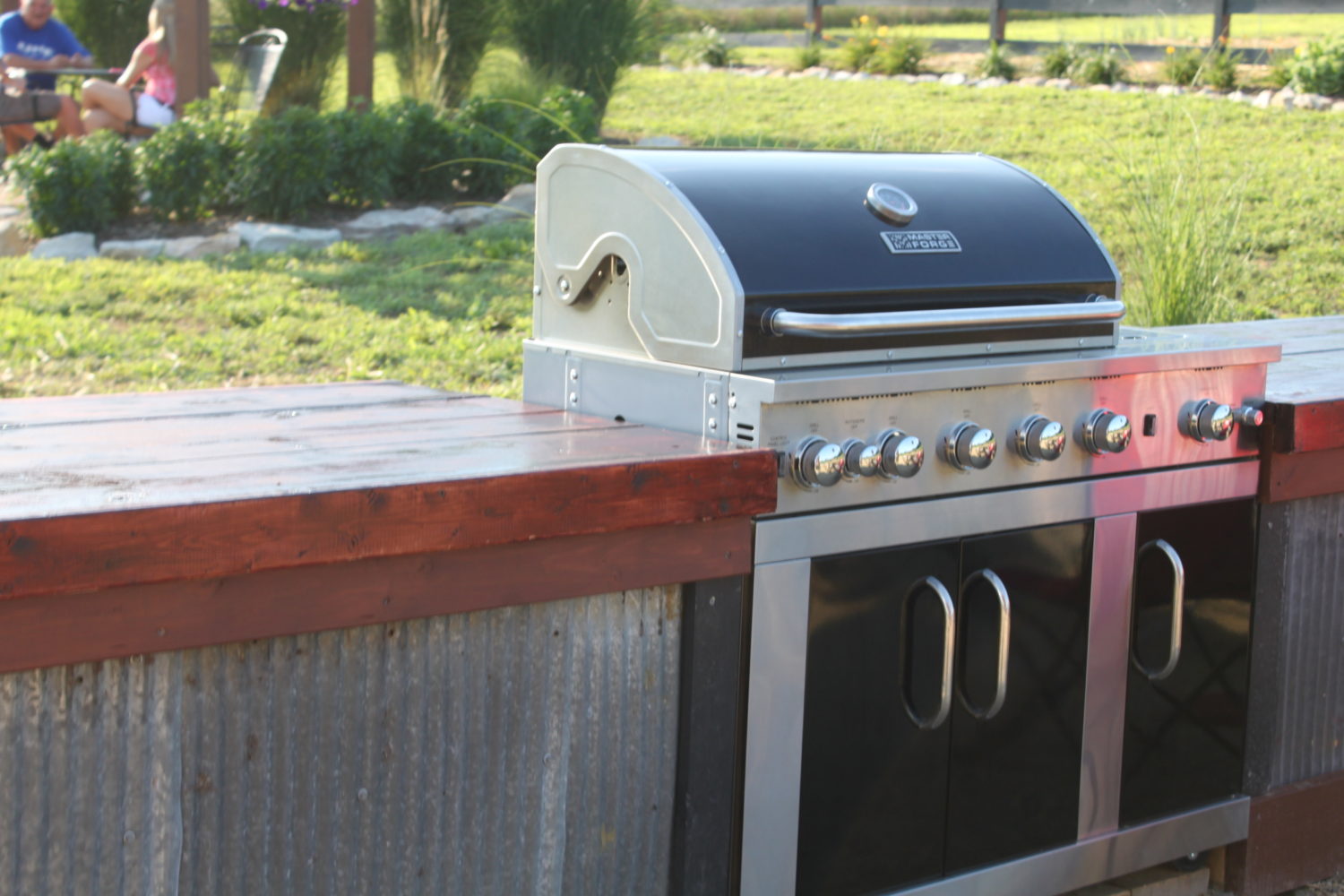
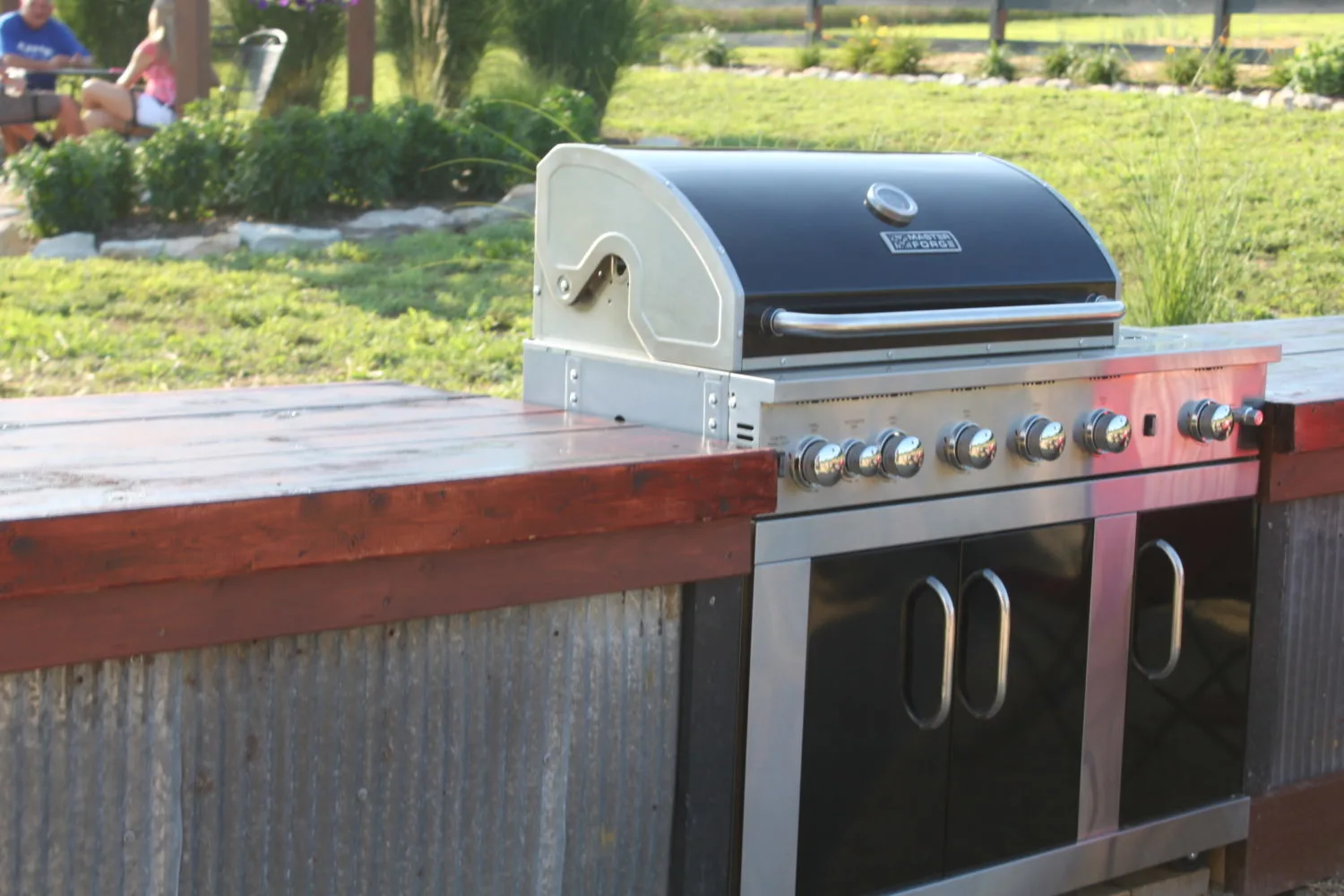
Outdoor Summer Barn Kitchen Completed

With the barn party deadline looming for this past Sunday (Barn Party photos and post coming Thursday! ) – Friday and Saturday became a mad rush to finish up the outdoor kitchen before guests arrived.

We started by making the frame from  2 x 4′s – using treated lumber for the bottom

We added more of the old barn roof material for siding and trimmed it out to match barn

We used the same recycled materials to match the barn

Wooden countertop on and grill slid into place

When we first started to put down some initial designs on paper – one thing we didn’t want was a typical brick, mortar or stone outdoor kitchen.  We wanted something unique, and we wanted it to match the existing barn and reclaimed brick patio. Even more – we wanted to make it from the left over recycled barn materials we already had on hand.  The only other requirement was to make sure we had enough counter space on each side to be able to easily prepare food straight from the garden to the grill.

We finally decided on a simple straight line island design. 14′ long, with a 48″ grill and burner slide-in space in the middle. Each side would then be flanked by 5 foot overhanging counters.  We made the width of the counter 34″ to give extra surface room to prepare and serve foods.  With limited time – we opted for a simple wooden top for now to match the farm table – however- as future time allows – we really want to replace with some stained concrete countertops.

THE BUILDING PROCESS
We first built a simple 2 x 4 stud frame, leaving a 48″ space in the middle and front for the grill and burners to slide in.  We used treated wood for the bottom to sit on the brick pad – and then built the rest from standard 2x lumber.  Next -we encased the inside of the grill area with cement board to protect the structure from the heat of the grill.  Then sided the entire structure with more of the left over corrugated roofing and trimmed it out to match the barn.

All that was left was to slide in the grill – attach the top and the outdoor kitchen project was complete!

Shared on The Barn Hop, Frugally Sustainable and the Funky Junk Interiors Saturday Night Special and Time for a Party

The Recycled Barn Trestle Table – Seating for 14

Our Barn Trestle Table made from our left over barn wood. 12′ long = 45″ wide

Nothing will quite make you finish up projects like hosting a party.

The barn table project has been on the “to-do” list for sometime and was one of our “TOP 30 GOALS” to accomplish for the farm this year. So, with our first barn party scheduled for this weekend, and needing some extra sitting and eating areas for the guests – this was the week to tackle the project.

We wanted a big long table that could seat at least 12 – so we made it 12′ long and 45″ wide. Eventually we will make matching benches to go down each side – which will seat 6 to a side.  If we  added a chair to each end –  it would give us a total of 14.

The old 2×4 barn rafters we had saved for this and a few other projects.

We started by building the trestle out of the old 2 x 4″‘s barn roof rafter pieces from the Cardington Barn we took down last summer. Not your typical 2×4′s – these boards are made from old growth solid red oak, and unlike today’s lumber – actually measure 2 x 4″. I just used a sawzall and cut them smooth – leaving all of the character of the old nails holes and dents of the wood in tact. Grey and weathered – they made the perfect base material for the table.

The trestle base. We had to pre-drill every hole to get the screws in because of how hard the old wood was!

We made the trestle base 9′ long – with angled 2 x4′s supplying all of the strength needed to hold up the 12′ top piece.

For the top piece – we just simply used alternating 2x8x12 and 2x10x12 pine boards and glued them together to make a large table top. We used ratchet straps in place of clamps (I didn’t have any that long!) to hold it together while it dried.

2 coats of rubbed on stain and 3 coats of polyurethane to the top.

After that, Mary took over and applied 2 coats of stain with a rag – and then finished it off with 3 coats of polyurethane to make it strong and tough.  We also added some 1 x 4′s underneath and screwed  them into the underside of the table top to secure it all together.

It should be great for the barn party this weekend to give plenty of seating.  One more thing to mark off the list!

If you would like to follow along through the year and receive our weekly DIY and Gardening Posts – be sure to sign up to follow our blog via email in the right hand column of this blog, or click the link and follow us on our Facebook or Twitter pages.

The Barn Trestle Table set in place. Once the brick floor goes down in the barn – it should look complete!

A Barn Raising In Photos – How to Build A Barn When You Haven’t a Clue How to Do So.

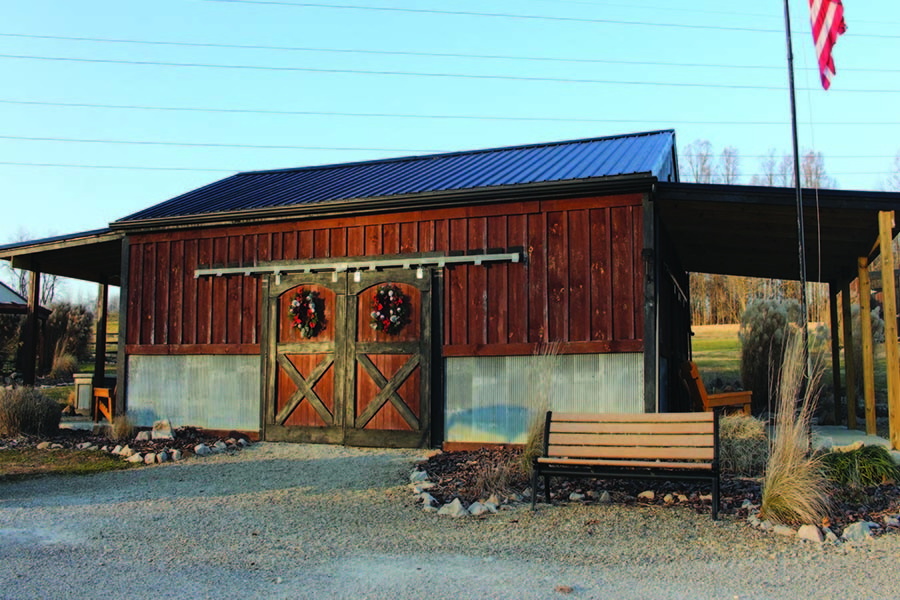
Our recycled barn as it looks today.

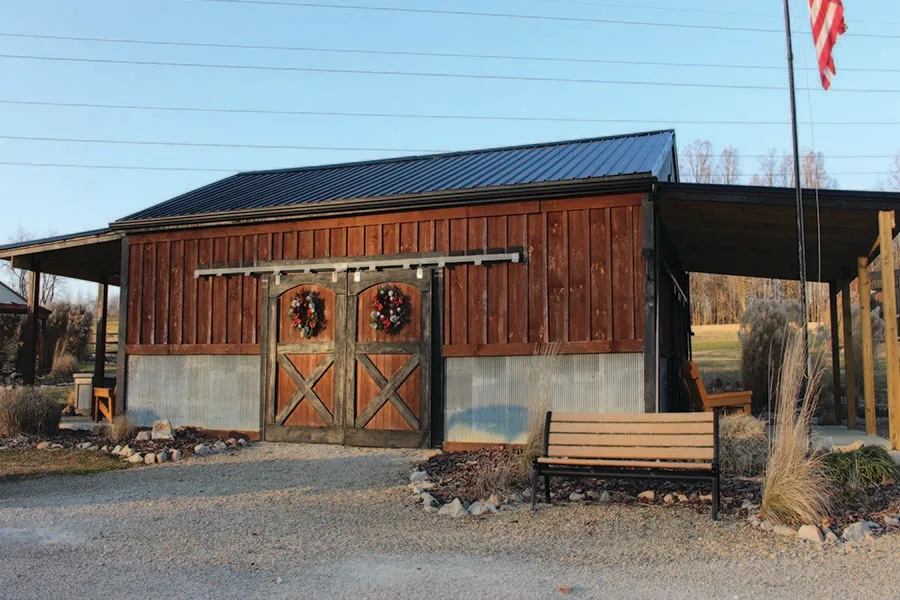
Our recycled barn as it looks today.

100% nuts! Looking back – that’s what we were! The idea came with a simple pencil drawing over the winter of 2010-2011. It was what we hoped would someday become the barn to our little farm. I’m not even sure how it really started, but the dream grew from that little drawing. Our hope was to be able to build the barn using some reclaimed lumber from an old barn. What it became was a project of tearing down two barns and building a new one from it.

It started as a wishful drawing in the fall of 2010.

As we get ready to host our first ever barn party this weekend – we took a second to look back in photos at our once in a lifetime project.

I will be the first to tell anyone we are not barn builders. We did a lot of things completely backwards : i.e. – who puts up walls before a roof, and even more – who starts hanging signs in the barn for decoration without a roof! But we built things when we could and when we found materials. So it didn’t always follow traditional building plans. We re-used and recycled everything we could find a use for – like the old roof barn to become our new barn’s lower siding. But we had a vision – and we stayed the course with a lot of help from friends and family – and a lot of advice from a lot of people.

Late 2010 – A big pile of overgrown brush waits to be cleared.

And now that it’s finished – We can reveal some of the scarier moments along the way. Like that the reason we waited so long for the roof was I was completely unsure how to build it. But we figured it out :) We can also now say we had no idea how we would tear down the Cardington barn or dad’s by ourselves and haul it back – but we did it. And we can now say – that we really had no idea how we would ever be able to make our barn doors from the old floor boards – but we somehow figured it out. And we had a blast along the way. Yes – there were injuries and losses – the smashing of many of Mary and I’s fingers – the knocking myself out when a board snapped me in the head – or Mary running over and destroying her cellphone with a 25′ rollback truck. But they were all worth it! So here it is without the pain – the barn raising in photos:

Shared On Southern Savvy Style Wow Us Wednesdays and All Star Block Party, Funky Junk

October 2010. It took us an entire weekend – but the brush is cleared and mowed off.

Early in April of 2011 – we marked out the barn with some string and stakes.

June 2011.  Leveling the land. Our neighbor Dave came in with his bulldozer and leveled off space for the barn pad. He has some serious grading skills and is amazing to watch work.

July 2011 – We tear down the Cardington Barn piece by piece and haul back to the farm. Sore – Sore – Sore nights!!!

Late July 2011 – Next up  came the digging of the poles. I have to say a bobcat and an auger bit are much easier on the body than digging by hand!

First of August 2011. Mary and I set the 6x6x16′ poles one by by one over the course of one weekend – Neither of us could move for another week! :)

2nd week of August 2011. Taking a break from our pole setting – we tear down Dad’s barn with the help of Family and Friends. It should be noted this went much smoother and easier on the muscles with the added help of extra hands taking it apart!

Mid August  2011.  So not the normal way to build a barn – but we started to put up the lower walls with the roof from dad’s barn. We wanted to make sure it fit and looked good.

Mid August 2011.  So who needs a roof when you can put up walls. We had the boards so next went the rough sawn pine. We milled down the old board from dad’s barn to use as the batten strips. We also brought out the doors from the house and leaned them up where they would eventually be hung.

1st of September 2011.  Still waiting for the roof – we decided to go ahead and hang the “fresh egg sign” we had made from the old floorboards from the Cardington Barn.  Its neat looking back and seeing how much deeper blue the sky becomes in the fall

2nd week of September 2011.  We cut all of the rafters in a few days – the hardest part was making the first one.  This is where the pergola building skills payed off !!  At least we were used to making a lot of precise cuts!

1st of October 2011.  Finally – with some HUGE help from my brother Bob and two brother-in-laws Brian and Rob and a nephew Ryan – we put up all of the rafters on a beautiful fall day. Family can save you!

Late October 2011.  We began the process of putting up the roof.  Mary and I would put up a panel or two each trip – then we had some late help to finish it off from a good friend Nate and my brother-in-law Brian again.

December 2011.  With the roof on – and over the course of the winter months – we installed the loft and began to close in the upper sides.

Late February, 2012 –   We installed the barn doors that had been leaning there “pretending” to be hung. It was a great feeling to finally close the doors with a roll.

March / April 2012 – Finally, something we know how to do :)  We began to mount the barn pergola in early spring.

Late April 2012.  Barn pergola finished up and stained – on to the landscaping!

May 2012.  In between spring rains – we also began work on the back landscaping wall – first up – installing all of the drain tile to carry water away from the hill behind the barn.

Continuing on with the back wall project – we installed boulders to create a break in the hill and to allow for landscaping all around barn

Barn back wall finished up – all of the transplants just need to a year or two now to fill in

Late Mary 2012.  It was nice to finally have the gutters installed – it allowed us to finally get the water holding tanks set up and working.

Late May 2012 – one of our biggest accomplishments – getting the rainwater collection system installed. It has allowed us to water all year through a hot summer with 100% reclaimed rain water. So far to date – we have used over 1000 gallons of rainwater in the garden.

June 2012.  Next up – using all of the reclaimed brick to make the patio – this didn’t really take too long – we had it finished up within a couple of days.

Barn Patio finished up!


The Barn Doors We Made From Barn Floors


The Barn As It Stands in September 2012

Making Garden Signs From Old Barn Wood

We have used pallet wood and the left over barn wood from the two barns we tore down to do just about everything.  This past week – Mary came up with one more great idea.  We wanted a way to mark the various rows of our gardens – mainly for appearance and to help identify plants and rows for visitors to the farm.

It was actually a simple project.

Our garden signs made from recycled barn wood and pallet wood

A quick sanding of the boards and a little paint – and the signs were ready to go

We still have a fair amount of the barn wood left over – including a lot of small 24 to 36 slat and floor pieces.  We trimmed them all down to be about 3″ wide by 20″ long – and then added a simple rounded curve on each end with a jigsaw before stenciling in the names of our plant rows.  We then pre-drilled a couple of holes on each end.  Th

en then drove 3/4″ x 18″ stakes into the ground. After that – we attached the painted boards to the stakes with some inexpensive course black drywall screws (We figure if they rust a little it will just add character) and we were finished!

The markers all up and in the garden – we just attached them to a simple small stake and drove them in the ground

The result -  a creative way to identify our garden with unique signs – created for free from our stash of old barn wood! We thought about adding a clear coat to the signs, but figured it was best to let them naturally fade and bleach with the sun. All in all, a great way to use up some more of the wood and not have to spend a dime on signage for the garden. It took us about 2 hours to make and paint the 25 or so signs – and 15 minutes to put them up.

Happy Gardening – Jim and Mary

If you would like to receive our DIY & Gardening Tips every Tuesday – be sure to sign up to follow the blog via email in the right hand column, “like” us on Facebook, or follow us on Twitter


The Flag Flies Again – A Piece of Family History Restored

A fitting tribute to Independence Day – The ol’ flagpole once again proudly flies the American Flag.

One of our “Top 30″ goals for 2012 was to resurrect the old flag pole that used to fly at my Mom and Dad’s house.  My dad had built the flagpole from recycled iron piping in 1976 – and I can remember hoisting up and down the flag hundreds of times growing up.  It proudly flew the American Flag until sometime in the early 2000′s, when the pole rusted through at the base during a summer storm and fell over.

The flag pole before sanding, priming and painting

Every single one of my brothers and sisters, and even my oldest niece remember the pole – and how we put our hand prints into the concrete the day my dad poured the foundation.  Dad then inset a 1976 Bicentennial quarter into the concrete to date the occasion.  In fact, the old concrete base with the hand prints is still in the ground today at the house – and you can still make out all of those little fingers in the concrete.

When we took down my Dad’s barn last fall – we found the 25′ pole up in the top of the barn rafters, and we knew at that moment it had to become part of our “new” old barn’s landscape.  So we hauled it back to the farm – and put it on the “to do” list for the coming year.

The flag pole foundation hole – dug deep to add strength

Figuring there was no better time than the 4th of July – we began the process of putting the pole back up.   We purchased a 6′ heavy duty length of 2 1/2″ galvanized pipe to secure into the ground.   And after digging down about 42″ – we mixed and poured the concrete and leveled the base pipe of the new flag pole. While I dug out the hole – Mary sanded down the old pole and primed it before adding two coats of high gloss black paint to make it “brand new” again.

We created a square form for the top – and – to honor the heritage of the pole – placed another bicentennial quarter in the concrete – along with a 2011 quarter to commemorate the new barn project started last year.  Since our base was a little smaller at the top, we opted to put just our thumb prints into the concrete.

The 1976 and 2011 Quarters along side our thumb prints

I’m always amazed looking back at my Dad’s ingenuity - but as Mary sanded down the pole – she realized he had made the top “ball” ornament of the flag pole out of an old wooden ball – probably re-used from something he had found :) – but as with everything he did – it looked and worked great!

After drying and curing – we slid the old pole down inside the base – installed a new rope and pulley – and at 5:35 pm on July 4th –  we rose the American Flag up the pole once again.

Preparing the pole – Probably the scariest moment was picking up the pole to slide it into the base. Once done – we secured the new rope and the project was complete!

Barn Landscaping Project Finished On A Dime – Before and After Photos

Finally – It is finished!

It is finished! Last night the last pile of rock was leveled out for the outdoor kitchen – the last rocks put into place on the hill – the final bags of mulch laid down – and the last few plants transplanted into the landscaping.   The retaining wall and barn landscaping are finally finished!  It has been a long continuous 3 month project – starting way back on the 28th of February when we began to transplant grasses into the hillside. The best part of all, other than a lot of labor – we were able to do it all with mostly reclaimed materials and little cash. Now – it’s all about maintaining and hopefully watch them grow into what we hope will become a beautiful back wall.  The plants are doing well so far – out of the 140 or so transplants – we had 135 survive.  The grasses should get to about 50% of their final size this year – and then next year should be full go. All that’s left now is to build the outdoor kitchen with the reclaimed barn materials and seed a little grass around the edges. What we really want is to sit back for one evening – fire up the grill – and finally…FINALLY enjoy a grilled meal on the patio!  We put some full before and after pictures at the end of the post to show the 3 month transformation.

The Final Totals:

135 transplants of grasses, daylillies and landscape plants that we started, divided or propagated from existing plants   TOTAL COST : $0

24 ton of boulder rock – 25 ton of limestone screenings – another 18 tons of #8 gravel for a topcoat – TOTAL COST: We were able to purchase it all for the cost of selling a few pergolas and selling off some extra barn wood from our reclaimed stash.

1275 bricks for the patio – gained for free from the flooring of the old barn we reclaimed.  TOTAL COST: $0

Patio Edging – this was the killer – TOTAL COST $125 – but such a must to keep the patio square. Really hurts when you have more in the edging you don’t ever see – than in the actual patio!

Drainage Tile – $125 – That includes the rental of the trencher and tile. Again – more labor than anything – but something we had to install so that the wall and barn stay put for a long time!

Mulch – 75 bags – TOTAL COST:  $75.00 – All purchased at .99/bag by buying damaged bags from a mulch distributor.  A little extra effort to get and lay down – but so worth the savings!

About 200 hours of labor – TOTAL COST – countless sore muscles, sore backs, two smashed fingers – a bruised shoulder and poison Ivy for Mary – but otherwise – $0

The massive bottle of Ibuprofen we went through – $13.50  :)

So here are some before and after pics:

The back hill on Feb 28th – putting in the grass transplants

The Hill with all rocks in place as of June 21st

The Front Patio Area – Feb 28th

The Barn Patio Area – June 21st. Still some minor things to attach to the pergola tops.

The back side of the barn – Feb. 28th

Back barn area – June 21st


Here are 1 year old transplants from last years project on the stand alone pergola – we hope our back wall plants can grow the same!

The Barn Pergola Patio Begins

Finally! Something that we are going to see. After the last few weeks of digging ditches and drains and a whole lot of work that only gets buried – we  began to lay the brick for the barn pergola patio.

Piles of reclaimed brick are a pretty common site around the farm – it will be nice to finally see them put to use.

All of the brick for the project is reclaimed from sites all over Ohio.  A large portion came from the brick floor to my dad’s old barn and the Cardington, Ohio barn we tore down late last summer.  Still more from old brick patios in Columbus and Zanesville, Ohio.  The end result is a large stash of brick that we hope to blend into a really unique pergola patio floor.

We tested several patterns to get the right fit and look with the reclaimed brick

When we first built the barn late last year – we had put down a good 3 to 5 inch base of limestone screenings.  It’s basically the limestone dust that is left over when quarries separate the various sizes of rocks through screens.  It’s a really inexpensive product (about $5.00 / ton ) – and is great to use for a base material of patios and walkways.  It fills and levels easily, and once it’s down and gets wet – it locks down and turns into a concrete-like base.  That really helped give us a head start on the patio. We simply added a few more inches of the screenings to level it and then tamped it down to give us a perfect working surface.

End of Day 1. About one-third of the patio is down. I’m sure work today will go much slower with sore knees and backs! :)

So with a little string – a level – and a whole lot of reclaimed bricks – we began to build it.  One thing is for sure, when your working with reclaimed brick from all over – nothing will ever fit “perfectly”.  We had to experiment for a while with the pattern to decide on the look we wanted.  We finally decided to use a soldier course around the perimeter using dad’s old brick – and then fill in the main patio area with the red fired brick.

We worked last evening for about 3 hours -and made pretty good progress -about 1/3 of the main patio area is down.  Hopefully, by the end of the weekend -we can fill in between with mason sand – set down a couple of tables and chairs…and relax!  Oh wait – that’s right – we still have to brick the whole barn!  Oh well, all in time…..

Looking down from the garden at the progress on the patio.