The New Chicken Coop Is Completed – Building Security For Our Chickens

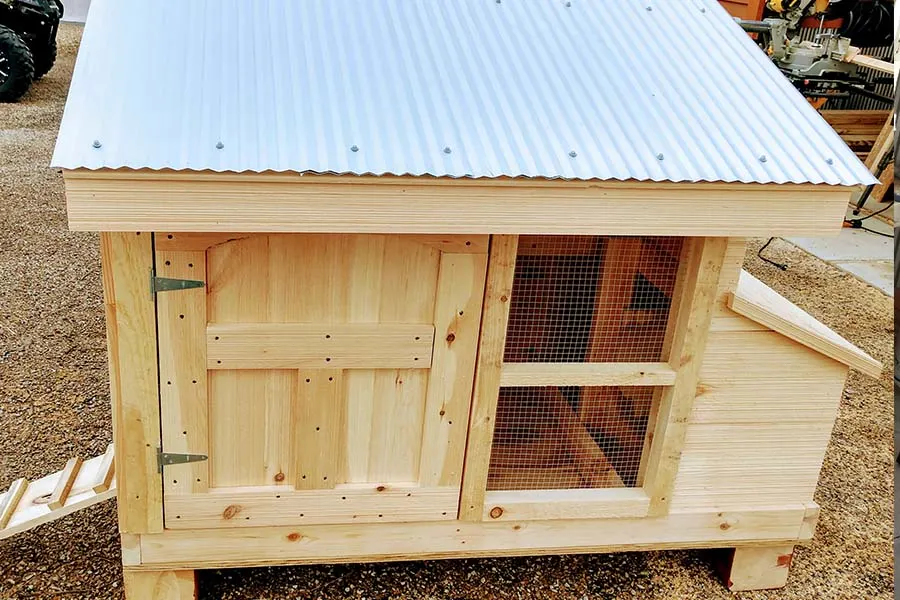
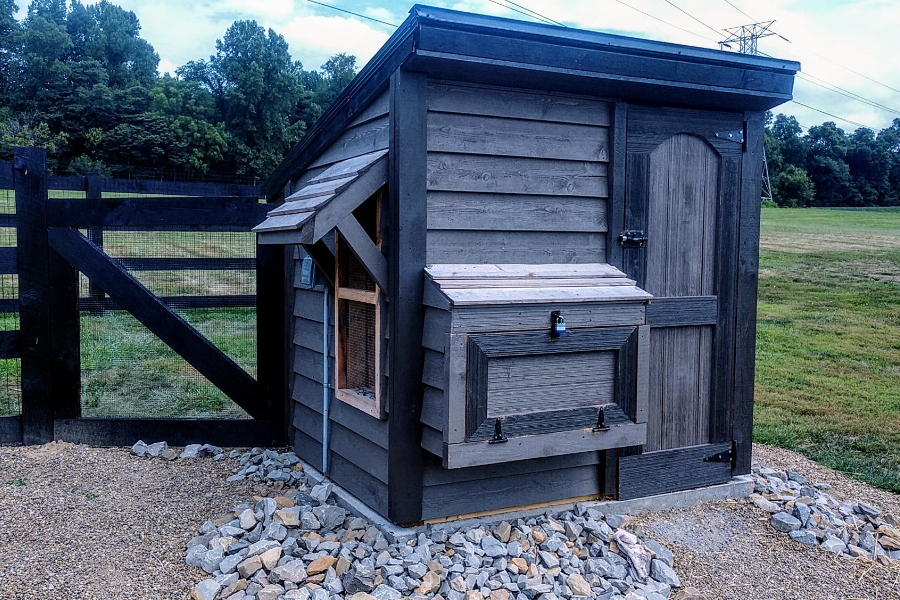
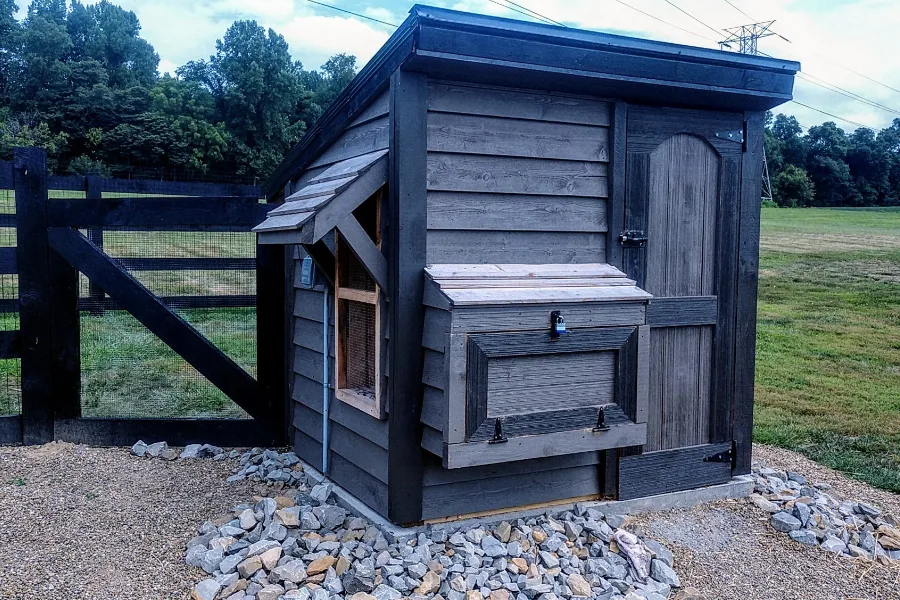
The new coop - a much larger and hopefully more secure home for our girls

The new coop – a much larger and hopefully more secure home for our girls

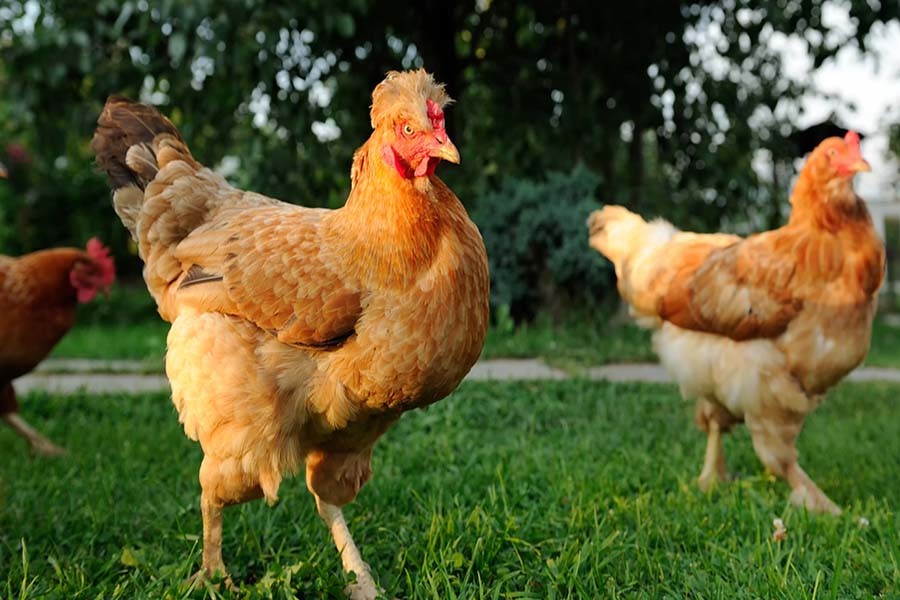
The new chicks are getting big!  They are ready for their new home.

The new chicks are getting big! They are ready for their new home.

1/2" x 1/2" heavy gauge wire mesh covers each of the three windows.  It is stapled and then backed with an additional nailed board.

1/2″ x 1/2″ heavy gauge wire mesh covers each of the three windows. It is stapled and then backed with an additional nailed board.

The coop was framed in 2 x4's - on top of a concrete block foundation secured with concrete and bolts

The coop was framed in 2 x4′s – on top of a concrete block foundation secured with concrete and bolts

The entire coop is covered in 1/2 strand board to keep out unwanted intruders

The entire coop is covered in 1/2 strand board to keep out unwanted intruders

A secured and covered run will be attached to the back - with 1/2" wire mesh used to secure the flooring and sides

A secured and covered run will be attached to the back – with 1/2″ wire mesh used to secure the flooring and sides

Finally!  The new coop is  complete. With just a few small finishing touches to make this week – it will be ready to house our chickens for years to come.  It’s just in time too – as our 18 little new chicks are more than ready to move out of the temporary pen in the garage!

We designed the new coop to mimic a traditional mid-western farm coop – and to match the barn.  We also kept with our re-use and re-purpose theme, utilizing recycled materials throughout.

Just like our barn – the lower sides are made from reclaimed barn metal roofing. The board and batten top siding are made from picket fence boards.  We were also able to re-use a lot of old fencing and wiring – and even the coop’s roof is reclaimed metal left over from a project.

We built the coop’s door to match the design of the barn – making it from simple 2 x 6 framing boards attached to a 1/2″ plywood back.  We curved the top 2 x 6 to mimic the big doors – and then filled in with picket boards to create the finished look.

The coop measures 12′ x 10′ – and 8′ high in front, sloping to 6′ 6″ at the rear. The added space will give lots of room for the girls – and even more for us when collecting eggs and cleaning it out!

If you follow along, you know that in the last 6 weeks, we’ve had some intruders into our old coop that unfortunately killed some of our older chickens.

It was a tough pill to swallow – especially since we’ve never had any problems in the two and a half years we’ve had them. We’re now almost positive the culprit was a mink.  So in addition to proofing the new coop for raccoons, coyotes and opossum – we used tightly spaced, heavy gauge wire mesh throughout to keep out mink and weasels.

Security For The New Coop:

A secure coop starts with a secure base – for ours we used a footer made from 18″ concrete blocks placed on a 6″ packed limestone base.  We then filled the blocks with concrete and embedded 1/2″ x 9″ bolts to attach and bolt through the 2 x 8″ foundation boards.

We built additional security into the floor – laying down a double layer of chicken wire along with a layer of wire mesh on top of the packed limestone floor.  We then secured it up and over the inside edge of the foundation and top sill board with heavy-duty staples.  We then added 3″ inches of packed limestone and 4″ of packed topsoil on top to create the finished floor.

Now – even if a raccoon, opossum or mink tries to tunnel under the 8″ concrete block and 6″ packed limestone base – they would still have to dig through the 3 layers of tight wire mesh and 4″ of packed earth to get into in the coop.

The shell of the coop is made from 2 x 4 studs – covered completely in 1/2″ strand board along with a breathable moisture barrier.

We made the door from some 2 x 6's, fence picket boards, and a 1/2" sheet of plywood

We made the door from 2 x 6′s, fence picket boards, and a 1/2″ sheet of plywood

We installed tight, heavy gauge 1/2 x 1/2 inch wire mesh in the windows on each side of the coop to provide for good air flow – and then added a final 3rd large mesh covered window over the top door for additional ventilation.  All three windows can then be covered with plexiglass frames for the winter.  The door is attached with 3 heavy-duty strap hinges and double slide bolts to prevent anything and everything from being able to pry it open.

We still have some work to complete this week. The entire run – including the floor – will be encased in 1/2″ x 1/2″ heavy gauge wire mesh to prevent intruders – and will give the girls access to the outdoors 24/7.  We’re also adding gutters and a rain collection system to the coop, and later this summer will attach two solar panels on the back to provide lights and a water warmer for winter.  Beyond that and applying a few coats of matching barn stain to the coop – the chicken coop project can be crossed off the list!

Hope everyone has a great Sunday! – Jim and Mary

If you would like to receive our Gardening / DIY and Farm Updates each week – be sure to sign up to follow the blog via email in the right had column, “like” us on Facebook, or follow us on Twitter.

Keeping Our Chickens Happy In The Winter

The last two weeks on the farm have been filled with a lot of snow, wind and freezing cold temperatures.  It’s about this time of year that most of our friends and family start asking us how the “girls” are faring in the frigid conditions.  Our “girls” of course are our chickens, and surprisingly enough, with a few simple adjustments, they handle winter better than us!  Now don’t get me wrong, they are not particularly fond of the snow any more than us humans.  In fact, it’s funny to watch them when we open the doors to check on them.  They will run to the door, and the minute they see the white stuff on the ground, they stop, do an about-face, and decide to stay in the warm coop!

The Coop with it's winter blanket

The Coop with it’s winter blanket

With the door open during feeding time, Amelia wants no part of heading out into the snow.

With the door open during feeding time, Amelia wants no part of heading out into the snow.

The key to keeping healthy and happy chickens through the cold winter months is really quite simple.  Keep drafts out of the coop, keep the inside of the coop dry, give them extra insulation (straw), and make sure they have fresh (not frozen) water and food to eat.  If those simple needs are met – chickens stay happy and healthy even through the coldest of winter nights.

I think a lot of our friends and family are surprised that we don’t have heaters or warming lights in our coop during the winter months – but there really is no need if you have good shelter and it’s properly prepared for winter. Here are some simple basic strategies that we practice with our girls and their coop in the winter:

Keeping Out Drafts

Happy Chickens = Eggs.  Here are 3 of our "girls" enjoying the warmth of the coop and their nesting boxes

Happy Chickens = Eggs. Here are 3 of our “girls” enjoying the warmth of the coop and their nesting boxes

We cover each of the windows in late fall with a 1/4″ thick piece of clear plexiglass. This allows the light to still get into the coop, but keeps out the cold winter winds and drafts that can be so detrimental to the chicken’s health.

We keep their attached covered run filled with thick straw as well during the winter months, and if it gets too cold we can cover the small opening to the run with some heavy plastic strips that keep out drafts.  Make sure if you do have an outside run attached - that the small opening faces away from your prevailing winds – this will also help to keep out drafts.

Deep Litter Method:

One thing we do not do during the cold winter months is clean the coop.  Instead, we practice what is called the “Deep-Litter” method.  In very late fall, we give the coop one final clean-out.  We then put in a good 6″ to 10″ layer of straw all around, and for the next few months, we will add a few inches of straw every week or two on top of the old.  The new straw provides a nice clean, dry surface for the chickens to roam about on.  More importantly – the old straw below, along with the chicken droppings that are mixed in, will start to slowly decompose, releasing heat that helps to heat the coop and keep the chickens warmer.  As the winter progresses, we keep covering the old straw with a few more inches of fresh straw to continue the process.  In the early spring, when the night temperatures begin to rise, we will clean it all out and start fresh.  This big clean-out has an added benefit – it’s a great start to a new compost pile each spring!

 Water and Food:

Happy Chickens Lay Eggs

Happy Chickens Lay Eggs

With the simple practices above – it is amazing how warm the coop actually stays.  In fact, it is usually at least 20 degrees higher than the outside temperature.  Even so, one thing we do keep an eye on is their water supply.  On extremely cold nights, it will have the tendency to freeze over by morning – we just make sure to switch out a new watering bucket in the morning, and all is well.  It’s important to also keep their feeder full of food through the winter months. Without as much access to scratch and dig outside for worms and bugs, they need a steady supply of feed.

I always remember the four words of advice an old farmer told me when we first started keeping chickens : “Happy Chickens Lay Eggs”.  He couldn’t have been more right, and if you keep them dry and draft free through the winter, they are a lot happier!

Have A Great Sunday!  - Jim and Mary

Shared on Savvy Southern

Chicken Talk – Raising Our Hens

Our Chickens are by far the most popular attraction at the farm

All in all – I would have to say that the most talked about of any venture we have going on at the farm are the chickens.  ”The Coop” as we call it – is usually the first place visitors to the farm go to see.  Our coop has been home now for over the last year to our little flock (we started with nine).  With a few minutes of care each day – they have provided us with a little over 4 dozen eggs each week – and maybe even more importantly – an incredible supply of organic matter for our compost bins.

Our hens are not free loaders – they actually pay for themselves.  In a short time – we have developed a steady supply of farm fresh egg buyers who purchase our excess eggs, which is more than enough to pay for their feed and straw.

For those of you considering of raising your own eggs – here are some quick answers to the most frequent questions we get:

    • Kids love the chickens

      Amelia trying to fly in the early morning sun

      The Girls enjoying some pecking time

      Hens are not loud.  We have only Hens  and for the most part they are as quiet as can be.  Now – they do usually give a little dance and a short squak to proudly tell us they laid an egg – but beyond that – they are pretty quiet and very tame.

    • You do not have to have a Rooster to have eggs – and although beautiful and protective of the flock – Roosters can be loud – something to consider if you live in the city :)
  • On average – our chickens lay an egg five to six days each week. We raise Golden Comets (brown eggs) and  Leghorns (white eggs), which are both very good egg producers.
  • Chickens need the basics – water, food, shelter and a little space to roam and scratch -and they will lay beautiful eggs
  • And yes – farm fresh eggs are different. They are larger, thicker and so much better to eat than store eggs!
  • We spend on average 5 minutes a day to fill up the feeder – re-supply the water, and collect the day’s eggs.  And once every month – we will take and extra 10 minutes to clean out the straw in the coop and add to the compost bins – that’s it!

As simple as it has been – we are actually going to revamp and remodel the coop over the winter months and expand the flock to about 18 for next year. We have plenty of room, and with the growing customer base for the eggs – we figure we might as well have more.   Besides – we still have a little left over barn wood – and we might as well as add a little matching shade pergola to the chicken coop for all they have done for us :)

-Jim and Mary


Yes – Fresh Eggs Taste Amazing!

Raising Chickens

News From The Coop – The Hens are Happy!

George stops for an early morning pose outside “The Coop”

Of all the things we do on the “farm” – the one that seems to receive the most attention from everyone are our chickens.

The chickens were the first ever true residents of the farm – heading out in the early Spring of 2011 at the tender age of 8 weeks to their newly built home we call “The Coop”.  We built The Coop on the cheap from recycled shipping crates and pallets.  We then added some protective measures like welded fence wire to the bottom to keep out raccoons – and cemented in fence wire to their attached outdoor fence run to keep the raccoons, coyote and other prey from digging under and getting to them.  We had heard so many horror stories from other friends and farmers who keep chickens – so we took a little extra care in securing the coop.  So far - we have been fortunate enough to keep all of ours accounted for.

One of our nine – Sherwin Williams

We have nine chickens (all hens) in all, led by Big Mamma – our 10 pound + hen who is to say the least a little “weight challenged”.  She happily shares “The Coop” with the other 8: Amelia, Comet, Curious George, Co-Pilot, Digger, Foghorn, Goldie and Sherwin Williams (named for her love of pecking at paint).

Amelia quickly found a way to “fly the coop” – climbing up on the flat roof and escaping to total freedom

The Chickens don’t have complete free range anymore thanks to some chicken wire – but they still have a large green space to roam and dust

Goldie finds a worm in the straw

The Girls in their laying boxes – the nine hens provide an average of 8 eggs a day for us

They produce on average about 8 to 9 eggs every single day.  We certainly don’t raise them as a revenue source – however the 5 to 6 dozen we get each week is more than enough to keep us in fresh farm eggs.  So we sell the extra’s for $2/dozen to an ever growing list of farm fresh egg lovers.  It’s been a win-win for us – as it covers all of our feed and straw costs – and there is usually enough money left over for a pizza or two.  It’s amazing how quick a simple posting on Facebook can clear out our holding fridge of extra eggs.

When we first started out at the farm – we gave the chickens the run of the place during the day.  However, as landscaping and the garden grew -so did their ability to destroy the mulch and beds.  So earlier this year, we opted to enclose a 250 foot area with temporary chicken wire fencing  that lets them roam during the day, and keeps our garden and landscape plants safe from their curiosity.  We move the fencing every 3 or 4 weeks to give them a new area to explore.  As the garden comes to a close later this summer – we will move the temporary fencing around it and let them go to town.  They do wonders with the garden area- consuming hundreds if not thousands of bugs, weeds and weed seeds – all the while leaving “natural” fertilizer behind to help improve the soil for next year.

We will be performing a little remodeling on “The Coop” in the coming months – all in the name of creating a match to the barn.  We will be adding a 30″ high corrugated knee wall to the coop, and a miniature version of one of our pergolas to their “back porch” area that will give them some extra shade -all done of course to match the barn :)

Chickens really are so very simple to keep and care for.  They require very little effort – and if you give them a safe home, water, feed and a little space to roam – they provide countless benefits to your home and garden.  Not even counting the incredible eggs they produce, they keep insect and bug populations at bay, and provide a great source of natural fertilizer for our garden and compost pile.

We plan on adding another 6 to 9 chicks to the flock next Spring – and hope in the coming years to keep our flock at right around 15 hens.  After raising them and having fresh eggs – I don’t think we can ever really imagine a time in our future that we won’t have chickens.

-Mary and Jim

Happy First Birthday Girls – The Chickens Turn 1

Foghorn posing for an up close shot - Foghorn just enjoyed his first birthday on the farm

As Jim and I  took a small break last week between tasks at the ‘Farm’, we began to think of where we were last year at this time with our dream.  We sat up under the garden pergola and scanned the property and laughed about the day we spent hours researching how to raise day old chicks.  We had read about diseases, brooders, breeds, feed, etc….   until we felt comfortable that we could become suitable ‘parents’ to day old chickens.

Jazzy checking out the new chicks...

In fact, I am pretty sure we could have written the book ‘What To Expect When You Are Expecting…..Chicks”.

Just like new parents do, we brought them home to their well-prepared brooder and sat and watched them.  Yes,  sat and watched them sleep, wake up for a few minutes to eat and drink, and sleep some more.   We then introduced the girls to our black lab dog, Jazzy.  Now Jazzy is a ‘single child’ and hasn’t had to share love, affection, or snacks with anyone else.   She was very interested in the new arrival and wanted to be a part of the ‘watching’.  Of course, as nature progressed – and the girls got bigger – Jazzy also wanted to see what it would be like to try to put one in her mouth – so at that point – the dog and chicken show ceased!

The coop - now painted brown and black to match the barn.

So the day finally came.  We had finished building their coop and hauled it out the farm as the first “building” on the property.  We secured it with a wire mesh bottom – a brick floor, and a coop run that included burying a portion of the fence in concrete to make sure the raccoons and other predators couldn’t get to them.  And we watched them grow – and grow – and grow.  And every day we would check those boxes  waiting and waiting for that first egg.  And then it came – week 16 – a single tiny egg in the box!  I’d be lying if i didn’t say we jumped up and down.

Ready to lay eggs in one of their favorite nesting boxes.

We had done it – We had raised our girls to be egg layers.  Within another week – they started coming daily – and the chickens were established as our first succesful farm project.

The chickens have been one of the most rewarding and fun projects so far in the short time since we began the “farm”.

Chickens in the brooder - all lined up at age 4 weeks learning to perch

They not only provide us with an incredible bounty of eggs – but do an incredible job of keeping ticks, mosquitos and bugs of all sorts and kinds at bay.  They help control our weeds and give us great “material” to use in our compost pile.

We love sharing what we have learned with others, and how easy it can be to have and care for chickens in your back yard.  It’s somewhat funny – but it always seems that two questions come up more than any others when asked about our chickens.

1) Where is your rooster? and, 2) How did you train them to lay their eggs in those boxes?

Well, as many of you know – you don’t need a rooster to have eggs – in fact – in many cases – such as ours – the hens are much more tame and comfortable not having “Big Daddy” around :)    It also makes it a lot easier when not having to worry about the fertility of your eggs.  It’s pretty simple – no rooster – no checking for chicks!

As for that training part about laying in their boxes…I must confess we have a little fun now and then making up a tale about the intensive training process to get them to lay in the boxes – i.e. – placing music in the box, or special treats – or my favorite – the special “chicken” shock collars we use to train them …. only to break into laughter and let the perplexed faces know that it’s simply nature taking place – and chickens prefer to lay their eggs in those little boxes nests all on their own.    And please, no worries – we treat the chickens like family.  So even if there is such a thing for chickens as shock collars – we don’t use them!

A bountiful harvest of eggs from the ladies

So far – the chicken experiment has gone better than we could have ever expected.  We have yet to lose a single chicken in spite of many raccoon and coyote visitors to the outside of the coop.  Then, of course, the hawk  who came awfully close to snatching one late last fall put a little scare into us all as well.   In the last 365 days – our nine little hens  have given us an average of 56  eggs a week since about the 17th week of their lives – that’s about 2000 eggs – or 175 dozen eggs!  Not bad production for the ladies at all!  We have had plenty of eggs for family, friends and our own hungry kids.  We now sell a few dozen eggs each week to friends who want those great tasting farm fresh eggs – which has turned out to be more than enough to cover our feed and fresh straw costs for the coop (which run about $20 per month on average).

So Happy First Birthday Girls!   Thank you for a great first year on the farm – and here’s to another great one this year!

9′ long and made from recycled barn flooring – our egg sign for the barn.

Chickens sentenced to 6 months in a minimum security prison

“What is this fence crap? And why can’t I go in the garden anymore?”

While working at the farm this past weekend – we decided that it is time.  Our girls, the chickens, need to have more of an assigned “designated area”.  During the building of the farm, the chickens have truly been free range and had free reign of every space.  With little to get into or get in the way of, we have simply let them run around.   However, now that there are patios, and flowerbeds and a much bigger garden going in –  things have to change.   Chickens love to dig, they love to scratch – and they just can’t seem to distinguish between all the green grass and dirt that is theirs – and the flowerbeds, patio spaces and garden space that is ours.

Enjoying her last few days of true freedom, Amelia surveys the empty garden from a fence post.

Late last summer and into fall, as the garden season came to a close – we allowed them in to rummage.  If you have chickens, it is actually a great thing to do after your garden has run its course.  They had a field day dusting and rooting around in the straw – decimating the insect population, eating and devouring weeds and seeds, and dropping valuable fertilizer.  It became a daily ritual – we let them out of the coop – and away they ran to the garden.

But now it’s spring, and plants are about to go back in.  We have spent the last few days raking back in the mulch that they have destroyed while mulling about all of the newly planted flower beds.   So, we decided we better get a plan in action.

Goldie wants to appeal the decision.

Now don’t get worried. We are not banishing them to a 2′ x 2′ cage.  Oh no, these chickens are our friends…we want to give them lots of space to roam and scratch and be happy – and to keep laying great eggs!  But just not in our barn, garden and patio area!  So out we went this past weekend to purchase a 150′ roll of fencing and a large amount of temporary poles.  It will allow them to have  a 30′ x  40′ area to scratch and play in.  Our plan is to rotate them around the property every  week or two to a new pasture area.  A minimum security “country club” type prison sentence for the next 6 months so to speak…until they can taste the freedom of the garden again this fall.

Jim and Mary

Predator vs. Prey

Amelia Scoping Out The Land

So by now you know our chickens……Amelia, George, Big Momma, Sherman, etc….  Of course, every time we go out to ‘The Farm’ they look for us to let them out of the coop so they can roam the land.  Now that the garden has been cleared, they have gotten a little  more rambunctious and adventurous.  As we tackle various tasks on the farm, they tend to find new areas to roam, dust, and nest.  Unfortunately they sometimes end up vacating the property next to us.  Yes, this is land is occupied by homo sapiens to the dismay of many of our chickens, especially the leghorns.   In fact, one day, we were putting up the barn rafters and to much of the surprise of everyone, the chickens had found a temporary vacation spot underneath the raised deck of Ben, the neighbor.   Now, we are very consciousness about the strolling of our chickens.  We make sure once they cross over the property line that we go and walk them back into our boundaries the minute we catch them roaming.    That was until Mother Nature taught them to stay closer to home.

Amelia exploring every area of The Farm

This past weekend we decided to work on the roof-line of our barn.   In order to do this, we rented a hydraulic lift to help us on the inside of the barn to secure the collar ties.   After getting used to balancing our weight on the lift (no, we definitely are not construction workers), we had settled into a good rhythm of building and securing the roof all from within the friendly interior of the barn.   About three hours into today’s project, I was on the lift using the nail gun on the ridge board when  Jim had to leave where the lift was parked to go get another board.  Suddenly I heard and saw ‘the girls’ (aka our chickens) run quickly from various parts of our property into the barn area.  This commotion definitely made me take a quick break and look to see what was going on from the landing, 16 feet up in the air.  As I stooped down to look out the  front of our barn doors when Jim had just begun to start to walk out those doors, a hungry Hawk scooped down with his talons spread ready to preserve his lunch for the day.  Of course, my reaction was to SCREAM!!!!!!!!!!!!!!!!!   Since Jim was walking out of the barn he was at direct eye-level with ‘the beast’.    Without hesitation we both quickly began counting chickens.  1, 2, 3, 4,….etc….  Each time we counted we only came up with 8.  Where in Sam’s Hill is the 9th????  Oh no….George was missing.  Now George is the one chicken that does her own thing.  She is very curious and wants to check out anything interesting/new (thus the name Curious “George”).   I quickly let the lift down to the ground so we could search for her.  Jim and I both quickly scoured the land and after a final ditch effort, found her happily sitting in her nesting box laying tomorrows breakfast with not a care in sight.  SHEWWWWWW…… so the Predator wasn’t able to get any of the Prey.   We decided since they had been out all day that it was time to put them safely back into their home.  They were all huddled into one corner of the barn by now, not trusting the wild kingdom that they once explored.  I picked up two of them to carry them back to the Coop (as I had done many times before), and within seconds the whole flock followed behind without hesitation (which they had never done).  They were not taking any chances!    A couple of hours passed by and they didn’t even come out of the 4 walls of the coop to their favorite recreation area, the outdoor courtyard.   Mother Nature definitely has taught them, and us,  the predator vs. prey concept.

Safe in the Coop

What are you building? A playhouse, doghouse…A chicken what????

Our Chicken Coop out at the farm. Built from old shipping crates and pallets

The framing of the coop in our driveway

The framing of the coop in our driveway

The Coop at the farm with the framing for their outdoor run in place.

The Coop at the farm with the framing for their outdoor run in place.

So, how do you get eggs when you don’t have a rooster?  Seems like a dumb question now, but a sincere question I had over two years ago.   Chickens were a subject that I knew very little about.  The only thing I knew was that when I was growing up, a girl down the street had chickens and when we entered the coop we had to avoid the rooster, or we would come out with very sore (and sometimes bloody) ankles.

Jim and I both wanted to have our own chickens….not only for the novelty of being able to have farm fresh brown eggs, but also as somewhat of a financial incentive with 4 teenage children that like to eat breakfast.   So after weeks of internet and local research, we decided that we were ready to tackle the challenge of raising our own chicks.

We decided to ‘order’ 25 chickens from a hatchery in Ohio and anticipated that we would have 25 new family members by the middle of March.  We then set about building a small wooden brooder  in anticipation of “expecting” our little ones any day. Well, the middle the March arrived, with no word of the ‘adoption’ day.  As an excited ‘new’ mother, we called the hatchery only to find out that our pullets were on back order.  Hmmmmmm….not the baby shower that I expected.    Time was getting away from us…..we had to do something.   Back to plan A….so we headed to the local farm store to purchase our pullets.  (Pullets are those chicks that they can ‘guarantee’ are females).  Time to head out and pick out what we would end up calling “The Girls”.  We quickly picked out 10 chicks in a cardboard container and headed home.  After getting them settled in their new home, we sat for hours watching them under their warming lamp.  We had to introduced our Black Lab ‘Jazzy’ to the newest members of the family….interesting to say the least.   (we had to reassure her that the chirping noise wasn’t the same noise she found in the squeakers of her toys).  And then – after all of the excitement died down…we realized we needed to build their permanent home.  And construction then began on ‘The Coop’.

 Now remember, we don’t live on ‘The Farm’.  We live in a typical residential neighborhood with neighbors within a throwing distance from us.  We have frequent walkers that pass by the house and always give a friendly wave hello.   So when we decided to build what we now call “The Coop”, we had to do so in our driveway where we had the modern convenience of electricity.  Using old shipping crate wood and some pallet wood, we decided to build the chicken coop primarily out of reclaimed materials.  After week one, we not only had a frame to our structure, but a pretty significant start to the future home of the chickens.

Farm Fresh Eggs

Farm Fresh Eggs

Spring was in full force at this time, and after the snowy, cold winter, several couples in the neighborhood had decided to take up walking as a form of exercise.  Each day we would hear general comments from them such as,  ”looking good”, and “keep up the good work”.    It wasn’t until the actual outside structure was built that we started getting more curious looks and the occasional question like: “Ok, you have to settle the bet, are you building a playhouse or a dog house?”.  To much of their surprise, we would laugh and tell them that it was actually a chicken coop – followed by a quick clarification of: “Don’t worry, it’s not staying in the driveway, we are moving it out to the farm”.

Now, we live in a small community, where the head football coach of our small high school lives just up the street.  Without hesitation, one day at school he approached one of our boys and commented, “Son, you are going to have the most elaborate dog house on the block”.  To the horror of our son, he shyly admitted to Coach that it wasn’t a doghouse at all, but a chicken coop in progress.   Guess there are worse things a teenage boy could endure:).