Starting Our Seeds Indoors – Let Spring Begin!

Finally…A Sunday Farm update with some garden action!…well, sort of.

The planting of seeds indoors signals the start of Spring for us - no matter the weather outside!

The planting of seeds indoors signals the start of Spring for us – no matter the weather outside!

Using the plastic seed domes, or even a piece of saran wrap can keep the humidity level up to help seeds germinate

Using plastic seed domes, or even a piece of plastic wrap can keep the humidity level up to help seeds germinate

It’s always such an incredible feeling each year to finally start putting seeds into the soil.  It gives you that sense Spring is finally close at hand!  So what if there is still a little snow on the ground outside from yet another passing storm system  - once you put a few seeds into soil, it’s time to grow!  We finally planted the first of them yesterday – our ornamental peppers.  The Ornamental Peppers tend to take a little longer to germinate and grow to full maturity – so we like to give them an additional head start by planting in Mid-February.

As for the process…there are thousands of websites, television shows, and gardening experts that give all kinds of advice about starting seeds indoors – and quite honestly, it can get really confusing!  For us – as with all of our gardening – the more simple we can keep it – the easier it is to accomplish, and the more we enjoy it all.  Starting seeds indoors in no different.

Seeds need moisture to sprout – but struggle to germinate if there is too much water or not enough.  The easiest way we have found to remedy that is through using plastic seed domes or plastic wrap, and a spray bottle of water.  We start by placing two seeds in every cell  - that way we can almost ensure a sprout to every cell.   It’s easy to thin them out later – but hard to replace if one doesn’t grow.  For almost all of our vegetable and annual seeds – we make a small indention about 1/8″ to a 1/4″ down with the end of a plastic knife, drop the seeds in, and lightly cover them up with the soil.

We use a small water bottle with sprayer to lightly soak the soil.

We use a small water bottle with sprayer to lightly soak the soil.  It’s an easier way to water and prevents the soil from becoming saturated.

Then, taking the spray bottle – we spritz a fine mist over the entire seed tray – enough to make the dirt stick to your hand if you touched it – but not so much that the dirt clumps or becomes water clogged.  We do not directly water it other than the heavy spritzing.  After that – we place the plastic domes or plastic wrap over top – and place them back on the rack – with no lights on whatsoever.  You should start to see a good amount of moisture on the underside of the plastic dome or wrap in the days that follow – and that’s perfect for getting the seeds started.

The seed domes are on and the seeds are all planted.  The lights will stay off until the seeds begin to germinate

The seed domes are on and the seeds are all planted. The lights will stay off until the seeds begin to germinate

After that initial spritzing of water, we will check them about every other day and make sure there is still some level of dampness to the soil.   If we see moisture on the underside of the cover – we know they are fine and can leave them alone. If not – we take off the cover and give it a few more shots of water spray to keep the humidity up – and that’s it.  Nothing more.

When you see a few seeds starting to break through the soil - it's time to pull of the covers and turn on the lights!

When you see a few seeds starting to break through the soil – it’s time to pull of the dome covers and turn on the lights!

We keep our shop lights about 1 to 2" above the plants.

We keep our shop lights about 1 to 2″ above the plants.

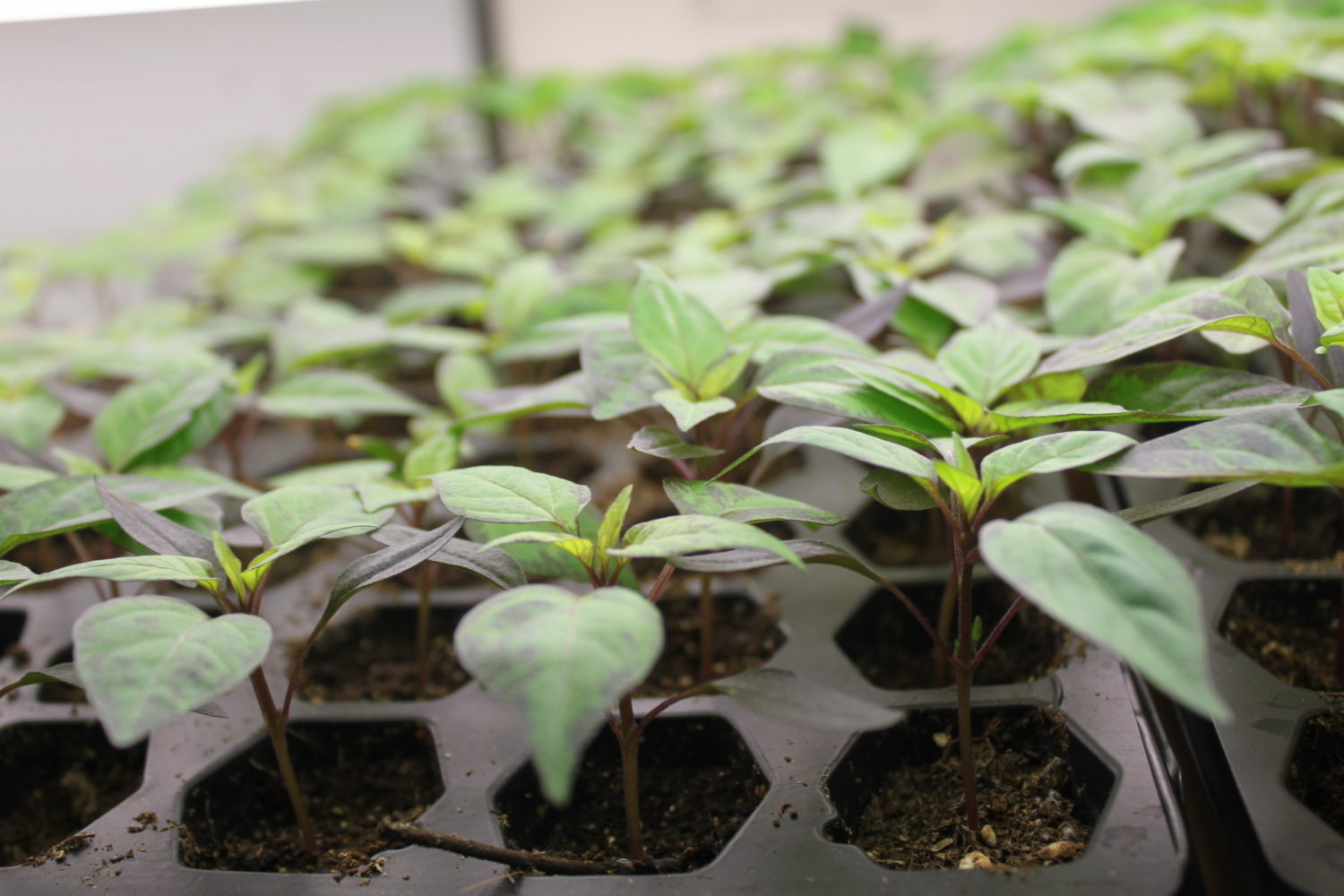
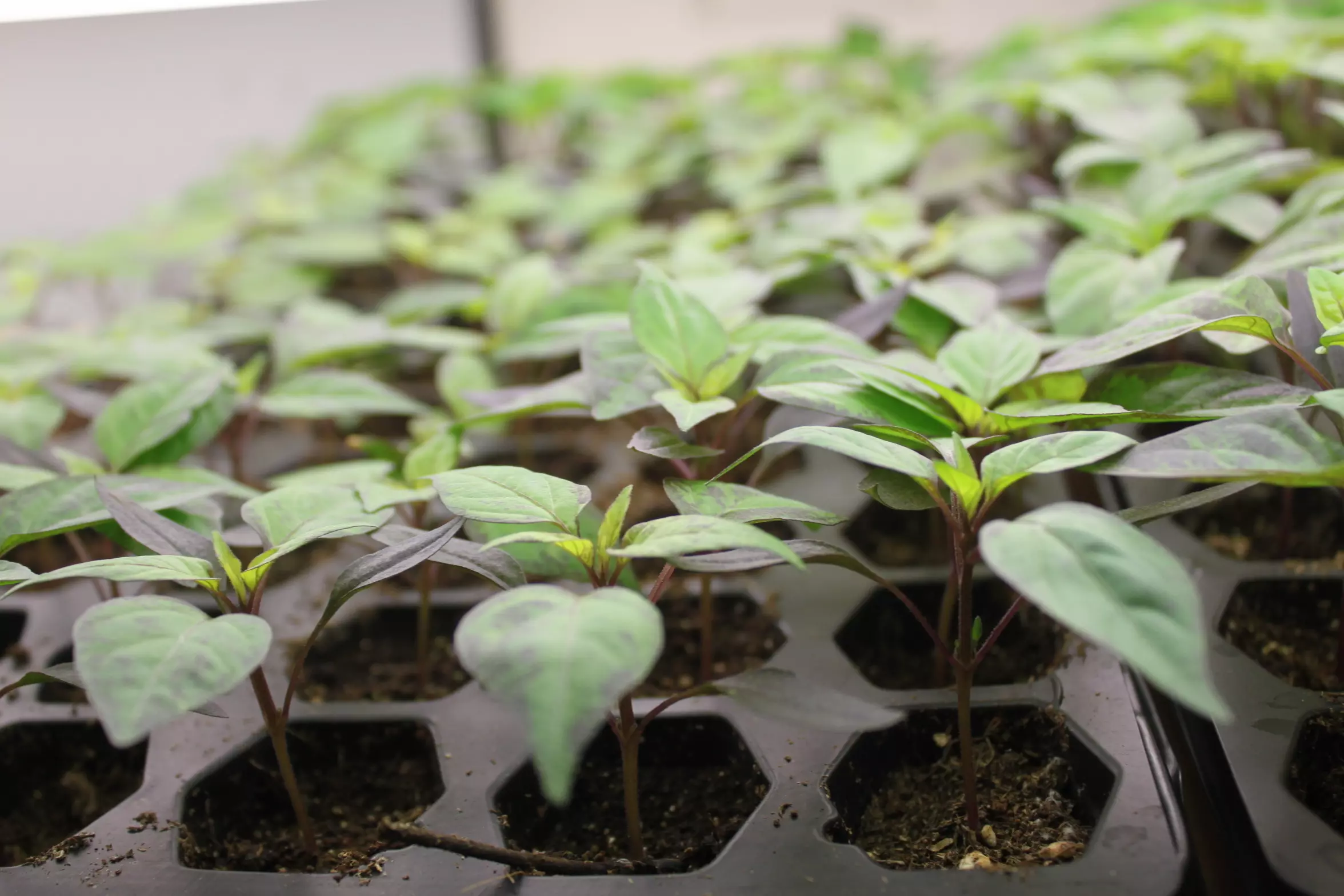
All seeds germinate at different times. Our Ornamental Peppers have a longer germination cycle – more so than our tomatoes and peppers.  It usually takes around 14 to 21 days before the first seedlings emerge from the trays.  At the point we see more than 3 or 4 popping up in a tray (no matter what we are germinating) – we remove the moisture cover and start turning on the lights for the plants. Seeds do not need direct light to germinate – so our grow lights stay off in the beginning.  Even then we will only water by spritzing.

Lighting is another big topic with so many options- again – we just try to keep it simple using regular old flourescent shop lights.  Once those first sprouts start  - we give them about 10 to 12 hours of artificial light a day.  We usually will flip the lights on when we get up – and turn them back off around 7 or 8 at night or later when we go to bed.   We keep the lights down close to the plants – at about 1″or 2″ above the top of the seedlings.  It keeps them growing strong and slowly.  That  is important so they don’t become “leggy” and weak trying to reach up too high for a light source.

So now that our ornamental seeds are in – we’ll wait another few weeks or so before we get started on the other vegetable plants we will grow.  It’s just such a good feeling to finally be writing a Sunday update about some real gardening – even if it is indoors!

I hope everyone has a terrific Sunday!!!

Jim and Mary

Shared on Savvy Southern

How To Easily Start Garden And Flower Seeds Indoors On The Cheap!

We start all of our ornamental pepper plants indoors.  Here are our

We start all of our ornamental pepper plants indoors. Here are our poinsettia peppers in mid summer bloom.

Our Sangria Seedlings At The Tender Age of 4 Weeks

Our Sangria seedlings at the tender age of 4 weeks.  The low hanging lights allow them to grow steady and strong.

I think one of the most rewarding experiences for a home gardener is starting their own seeds indoors. For one, it’s an incredibly satisfying feeling to make a tiny seed grow into a beautiful plant for you and your family to enjoy. It also can be a tremendous cash saver – plants can be expensive when purchasing them all at your local greenhouse. Especially if you want to grow specialty or heirloom seeds that are hard to find.

We use a low-cost, simple set up to grow our seedlings indoors.  It has allowed us to expand our garden and landscape without breaking the bank.

Let’s start with a few, money saving tips of what you won’t need: Heating Mats and Specialty Lights.

It’s not that heating mats don’t work – they do. They help warm the soil and help to germinate seeds.  But unless you live in a 40 degree barn…normal room temperatures will work. It make a take a day or two longer to germinate than if you use heating mats – but the seeds will grow just fine.

There is also no need to waste big money on high-priced “grow lights” or bulbs with a special light spectrum for raising seedlings. They do have a place for certain types of special growing applications – but if your goal is to start and raise seeds indoors – a couple of good old-fashioned inexpensive flourescent “shop lights” work incredibly well. Most of us have a few already around the house.  If not, they can be had at your local hardware store for about $10 to $15, and can be used year after year. I am a big believer in the lights.  Yes, it’s true that you can use a sunny window of your house – but it’s hard to get seedlings to grow straight using natural winter sunlight from a window.  You need to turn them constantly – and the seedlings tend to grow thin and skinny trying to reach up for the light.

What you will need to start up to 4 flats of seeds indoors:

A couple of inexpensive double shop lights -and we can raise 4 whole flats of seedlings.

A couple of inexpensive double shop lights are more than enough to grow 4 whole flats of seedlings.

One (1) 32 quart bag of potting soil or seed starter mix.  We make our own from equal parts of our compost, sand and soil, but if your starting out, you can buy a good bag for around $10.  It will be more than enough to fill four flats and have some left over for next year.

Two (2) inexpensive dual-bulb 4′ flourescent shop lights. (4 bulbs total)  You can pick them up at your local hardware store for about $10 – $15 – and most all of them even come with little hooks and a chain for hanging over your plants.

Plants ready to head for the garden and landscape!

Plants ready to head for the garden and landscape!

Four (4) empty flats with seed tray inserts.  (we like the 36 cell plant trays – the individual cells are big enough that you won’t need to transplant the seedling into anything else before they go into the ground)

A few blocks of scrap wood and two 5′ 2×4′s to hang your lights from.

Your seeds of choice.  Whatever seeds you use – make sure to label your flats with what you plant in them – it’s easy to get them mixed up as they grow into mature plants.  As for when to start your seeds – the back of each seed package will usually tell you the optimum time, however, a general rule of thumb is 6 to 8 weeks before planting outdoors.

The Process:

1. Fill your seed trays with soil mixture — pack lightly – you want the soil to be light and fluffy to allow room for root growth and water filtering through.   Moisten the soil –don’t drench.  You just want to have the soil wet to the touch – An empty spray bottle of water works great for the first few weeks of starting.

A young seedling emerges from the soil

A young seedling emerges from the soil

2. Plant your seeds at a rate of 2 per space – preferably not on top of each other, but in slightly different areas towards the center. Each seed packet will tell you the depth that the seeds should be planted — most are about 1/8″ to 1/4″ inch deep. Planting two seeds ensures that you can get at least one seed to germinate in every space. Yes, you will have to thin later – but better to have too many than none at all! After planting your seeds, lightly moisten the soil again and then cover with a clear plastic sheet or lid and keep out of direct sunlight.

The seedling emerges with two full leaves - now is the time to thin

The seedling emerges with two full leaves – now is the time to thin

3. I know it sounds strange to put them out of direct sunlight – but covering them allows moisture to build up and helps to achieve optimum conditions for the seeds to sprout. You will most likely not have to water during this time — just make sure the soil remains moist.

By using clear plastic you can see when the plants  actually come up without taking off the cover and disturbing the plants and releasing the moisture.

Young seedling growing into a nice plant

Young seedling growing into a nice plant

4. Once you see 1-2 seedlings sprouting out of the soil, remove the lid and place onto a table or flat surface.   You can now set up your shop lights.  You want the lights to hover down about 1 to 2″ from the top of the plants.  We do this by putting blocks of wood at each end and running a 5′ 2×4 over all of the flats of seedlings.  We then simply screw a little hook into the 2×4′s and hang them with a little hook.  (usually included in the shop light kits)  When we need to raise the lights as the plants grow – we just add another block of wood to each end.  You will want to give your plants about 12 to 14 hours of light each day.  (For how to build a cool indoor seed rack stand on the cheap – check out our latest article here : Indoor Plant Rack Stand – On The Cheap)

Plants need to be "hardened" off to adjust to real light and temperatures before planting outdoors

Plants need to be “hardened” off to adjust to real light and temperatures before planting outdoors

You will also need to water more frequently now — most likely once a day – and as the plants grow in the coming weeks – you will continue to adjust those two lights to keep them at 1 to 2″ above the top of the plants. You want the soil to stay moist but not water logged.  This is also the time to start thinning to allow for one seed per container. If you have an empty cell, you can replant extra sprouts into the empty cells.  We just use a flat head screwdriver to lift out the extra seedling and plant into the empty cell.

The shop lights at such close range keep the seeds growing straight up and at a slower, stronger rate. One of the problems with using just direct sunlight is that the plants will get leggy as they reach to the light source. With the shop lights at such a close range..they grow nice and slow and develop strong roots and leaf structure.

The Sangria Peppers we grew from seed in full bloomAfter about 6 to 8 weeks – your plants will be ready to go. As the weather begins to warm – we will take our plants out onto the back porch to get some regular sun and start adjusting to the temperature and light. One thing to avoid is to take your plants directly from the shop lights and plant them in the yard – you want to give them time to adjust to sunlight and temperature – a process called hardening off. Usually by the end of March – we start to keep them on the porch longer and longer – and near the end – only bring them in or cover them if there is a threat of frost to get them ready for the great outdoors!

- Jim and Mary  

If you would like to receive our DIY and Gardening Post each week – be sure to sign up to follow our blog via email, Twitter or Facebook in the right column.

Shared on Frugally Sustainable

The Infant Years….from Seedling to Sprouts

Now that the weather has continued to stay at above normal temperatures in our area, several of you are getting the ‘gardening’ bug.  Typically the word bug would not be good in garden terms, however, we all began gardening because we saw the immense benefit that it provides to ourselves and our families.  These benefits may be more than you bargained for – the most obvious is the nutritional benefit, but many don’t realize the additional benefits that derive from planting your own garden: emotionally, physically, and even spiritually for some.

Our 4 week old seeds have grown to this

Several times in our lives we get the desire to do something, but have no idea where to begin.  Over the last several weeks, we have continued to filter questions from individuals that would like to start a garden from seed but don’t know how.  We always tell everyone, don’t be afraid to try — the worst thing that could happen is that you are out a couple of dollars from buying those seed packets.  You have to make the jump and get started…..now is prime time to start your seeds if you plan to get them in the ground right after the threat of the last frost.

Basic instructions for seed planting:

1. Purchase your seeds from your local garden center  (we will get into harvesting your own seeds in other posts)

–if you are an organic gardener, make sure you purchase heirloom or organic seeds — Don’t worry, the packet will tell you what type you are purchasing

– if you buy F1 seedlings, you will not be able to harvest the seeds from your produce next year, as these will produce genetically modified organisms that are designed to increase disease resistance in your crop but not produce the exact reproduction in future years

2. Purchase planting soil and compost  (if you don’t make your own — which by the way is very simple to do)

—Composting 101 http://oldworldgardenfarms.wordpress.com/2012/03/02/composting-101-tips-to-make-easy-compost/

3. Decide where to plant your seeds

Seed beginning to sprout

– peat pots are biodegradable containers that can often be planted right in the ground with your seedlings.

– we have reused yogurt containers to start some of our seedlings — just make small slices in the bottom of the container to allow for adequate water drainage

–check out your local garden store for various seedling containers

4. Mix the potting soil and compost in a 1:1 ratio

5. Fill pots with soil mixture — pack lightly – you want the soil to be light and fluffy to allow room for root growth and water filtering

6. Moisten the soil –don’t drench the soil so it turns to mud, you just want to have the soil wet to the touch.

6. Plant your 2-3 seeds per pot – preferably not on top of each other, but in different areas for easy thinning.

–each packet will tell you the depth that the seeds should be planted — most are about 1/4inch deep — It doesn’t seem like very deep, but it will pay off when you are waiting for them to sprout.

7.  Lightly water the soil

8. Cover with a plastic sheet or lid and keep out of direct sunlight

– Really?  I thought sunlight made seeds grow???  I know, I know, but you have to get the seedlings to sprout first.  The moisture that will build up between the plastic and the pots will allow for optimum seed sprouting.  You will  most likely not have to water during this time — just make sure the soil remains moist.

Sprouts have been thinned

9. Wait

10. Wait again, but continue to check to make sure the soil is moist

11. Once you see 1-2 seedlings sprouting out of the soil, remove the lid and place in direct sunlight (or use a shop light placed 2 inches above the soil)

12.  You will need to water more frequently now — most likely once a day.

13. Once seeds begin to sprout, thin the growth to allow for one seed per container.

– you can attempt to replant the seedlings in other containers if you have a steady hand – and yes, you will feel like a Surgeon.

–or compost your non-preferred sprouts

–or if you are afraid to disturb the roots, cut the non-preferred sprouts down to the soil and let die off, which will become compost in the current soil

Seedlings under shop lights

13.  If you are using direct sunlight, rotate the plants to allow for even growth — the plants will get spindly as they search for the sun…but don’t worry, when you plant them you will just have to plant them deeper (up to the first leaves) than the shorter versions.

14. If you use shop lights – keep the lights at 1-2 inches above the plants.

Sangria pepper plant in a yogurt cup - now ready to be trained to tolerate outdoor temperatures.

15.  After your plants have gotten 2-3 sets of leaves, you can begin to train them to tolerate outdoor conditions.   On a warmer day in your climate, set them outside for a few hours.  Increase the time that you leave them outside each day and even overnight if there is no chance of frost.

Plants being trained to the outdoor climate

16.  Don’t get greedy — you can’t plant them in pots/gardens until the last chance of frost in your zone — In our area, May 15th is the ‘safe’  planting day.  Of course, we live on the edge and usually plant by May 5th :)

In a few weeks, we will discuss our garden planting system — the No-Tiller method.  But right now you need to concentrate on getting those seeds started!!!

Happy Planting!

We are New Parents…well, sort of.

So we may not truly be new parents, but the anticipation and the excitement of  our seeds sprouting through the wet soil have made us feel like it over the this past week.

Seedlings sprouting for Sangria plants

We got an early start on planting the Sangria pepper seeds,  our famous ornamental pepper plants.   Jim actually bought me the first plant a few years back for mother’s day, and we loved it so much that we  ended up saving the seeds of the this rare plant because they were so hard to find at our local nurseries.  Last year we planted the seeds in mid-February, but because they take so long to germinate, we decided to plant them in late January this year to get a chance to enjoy the beauty of the plant a little longer this summer.

Sangria plants in a pot on our back deck

Last year we planted a little over a hundred starters.  We enjoyed giving them to our friends and family and looked forward to the pictures they sent us over the course of the summer.  It was exciting to see where they planted their Sangria plants and the hear how the peppers made progress as they turned from purple to red.  We also used some of our plants in our garden beds as a small ground cover plant.  They really did well and filled in nicely.  This year, I think we will plant even more and possibly closer together (we planted close to 200 seeds this year).

Ornamental pepper plants at the Pergola on The Farm

We also decided to expand our seed starter collection to include the Poinsettia hot pepper plant, and what we hope to be Sweet Tangerine Dream pepper plants.  I say hope because we believe we might have purchased a mislabeled packet of seeds.  The picture on the front of the packet is what we were hoping for (Tangerine Dream), but after some research on various websites, the name on the packet (Tequila Sunrise)  appears to be much different than the picture displayed on the packet.  Only time will tell — and heck, who isn’t up for some ‘unknown’ adventure…that is how great things truly begin, right???

We also decided late last year to reuse yogurt cups as an alternative to traditional seed starting containers for our herbs this year.

Reuse of yogurt cups as starting pods for our herb garden

We recycle daily, but one day Jim came up with the idea that the cups would make  great planting containers for some of our seeds this year.  And what a great idea it was!!!  Now we won’t have to transplant the starters into bigger containers; they will be large enough to go from the yogurt cups  and be planted right into the ground.  Then yes, we will recycle the plastic.

We hope to continue to expand on our seed garden every year and are always looking for something new and exciting to plant.  The best part of all, is sharing our starters with others.  We will keep you up to date on the progress of the plants and eventually the answer to the mystery seed question.

Happy planting…only 33 days until Spring!!!!

Mary and Jim